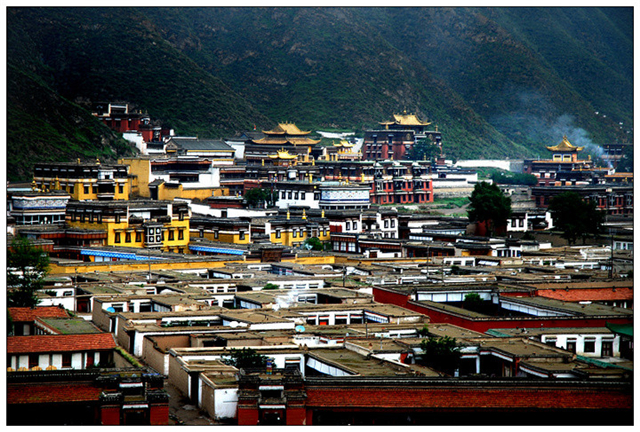
Labrang monastery is one of the six great monasteries of the Geluk (Yellow Hat) school of Tibetan Buddhism. Labrang is located in Xiahe County in Gansu province, and also considered to be in the traditional Tibetan area of Amdo. Labrang Monastery is home to the largest number of monks outside of Tibet Autonomous Region. Xiahe is located about 4 hours from the city of Lanzhou, the capital of Gansu.
Labrang Temple is located 0.5 kilometers west of Xiahe County, Gannan Tibetan Autonomous Prefecture, Gansu Province. In Tibetan, Labrang means the residence of a living Buddha. Labrang Monastery is one of the six temples of the Gelupa School of Tibetan Buddhism, and is known as the “world Tibetan institution”. Labrang Monastery was founded in the 48th year of the reign of Emperor Kangxi of the Qing Dynasty by the first master of Awang Song Zhe (1709). In the 53rd year of emperor Kangxi’s reign (1714), “Lazhang” (Jiamamu Buddhist Palace) was established. At its heyday, there were over 4,000 monks.
The owner of the Labrang monastery is the sixth Hutuktu living buddha, while other leaders include the eight Kambu and the four competitions. Historically known as having 108 affiliated temples (actually far larger than this number), it is the political and educational center of the south Gansu province region. Labrang Monastery has the best Tibetan Buddhism teaching system in China. The whole temple is the oldest and only temple built in the first living Buddha, which is the temple of the Lower College next to the Great Sutra Hall.
Labrang Temple sits north to south, covering a total area of 866,000 square meters, with a construction area of more than 400,000 square meters. Labrang Monastery has more than 90 major temples, including six colleges, 16 Buddhist temples, 18 Angqian (big living Buddha palace), monk house and sutras altar, Dharma garden, printing courtyard, pagoda and so on. These have formed a group of magnificent buildings with Tibetan characteristics, with no more than ten thousand houses.
The religious system of Labrang Temple is mainly composed of six colleges, Meditation, Medicine, Time Wheel, Tara, Upper Part and Down Part School. Among the monasteries in Mongolia and Tibet, the Labrang Temple has the most sound system
Meditation College is its center, also known as the Great Sutra Hall, with hundreds of houses in the front hall, the front courtyard, the main hall and the back hall. The college covers an area of more than 10 mu, which is a mixture of Tibetan and ancient palace structure, with gilded bronze tiles, copper goats, flun, prayer flags, vase and other decorations. It focuses on the dominant Buddhism, focusing on the five major theories of Indian Buddhists (Interpretation of Quantity, Prajna, Zhongguan, Facism, and The Theory of Discipline).
There are more than 10,000 ethnic cultural relics and Buddhist artworks. There are 16 bronze or sandalwood statues over 8 meters high. A variety of small and medium-sized Buddha, Bodhisattva, pagoda, Dharma ware and so on. Labrang Temple also treasures the clothes of the ancient masters and other articles of daily use, and the imperial seal and gifts, seals, letters, large plaques, thousand Buddha trees, pearl pagoda, jade Ruyi, meteorite, seahorse teeth and so on.
The main buildings of Labrang Monastery
Main Assembly Hall
The Temple has six Sutra halls, the largest of which is Meditation College, also known as the Great Sutra Hall, which is the place of conference. It is the center of the whole temple and can accommodate 3000 monks chanting sutras.
Time Wheel College Classic Hall
The Hall of the College is located on the right side of the hall, with a strong Tibetan style and the bronze statue of the Buddha.
School of Medicine
In the hall of medical school, the stupa of the Buddha, Buddha and Lako Cang are worshipped in the hall. The front corridor of the hall is painted with 18 pictures of human veins.
In addition to the scriptures of the college, there are many Buddha temples. The Buddha Temple is a place where monks recite sutras and believers worship. The more famous places are Tonkapa Buddha Temple, Thousand-Hands-Maitreya-Buddha Temple, Sakyamuni Buddha Temple, White Shield Bodhisattva Temple, Rescue Mother Hall, White Mother Temple, Shouan Temple, Wuzhen Temple, Pucheng Temple, Tudan Po Chapter and Dharma Hall.
Labrang monastery also has sutras building, printing courtyard, Yadan Lacan, Bodhi garden, mu villa, bronze tower, kitchen and archway. The building contains more than 60,000 volumes. Yin courtyard in front of the thousand hands thousand eyes Guanyin Hall, there are a large number of editions. Shadan Lacan, in the northeast corner of the great Sutra hall, is Panchen Lama’s palace. Bodhi Garden, which is a place for monks, is located in the south of Sahar village in the west of the temple. The house, is a simple bungalow, around the temple, about 500, inside the wheel. Bodhi pagoda, copper gold-plating, three layers high, very precious.
The history of Labrang Monastery
In 1709 (the 49th year of Emperor Kangxi of the Qing Dynasty), the first master returned from Tibet to his ancestral home in Tibet to build a temple and spread the Dharma under the invitation of the Mongolian King of Yellow River Prefecture in Qinghai. In the summer of that year, the master took his disciples to Zhaxitan. He saw the beautiful mountains and rivers and the lingering clouds here, which was the ideal place of building a temple. That is, the construction of the Labrang monastery began here. Through the continuous expansion and improvement of successive masters and various living Buddhas, it has developed into a building with an area of 866,000 square meters, construction area of more than 400,000 square meters, more than 90 main temples, more than 10,000 monk houses and six warehouses (colleges). In its heyday, there were more than 3,600 monks in the Labrang Temple. There are 139 temples, within the jurisdiction of Gansu, Qing, Sichuan, Kang, Mongolia, northeast China and Xinjiang. It has not only become a sacred religious Zen forest of Buddhism, but also a comprehensive institution for spreading knowledge, and the cultural and artistic center of the Tibetan nation in the whole Ando region.
The Labrang monastery paintings include murals and Tangka paintings. The murals include Buddha’s native life, Buddhist scriptures’ stories, Buddha statues, historical figures, medical illustrations, etc., bright in color and full of life atmosphere. Tangka painting is a scroll painting, painted on the strategy, very delicate. The embroidery art of Labrang Temple can also be called a unique, with a variety of colors of silk cut into various shapes, such as Buddha, figures, birds, animals, landscape, flowers and plants, insects and fish, embroidered on the cloth curtain, the bottom pad with wool and other things, has a strong three-dimensional sense. The plastic art city, sculpture, butter flowers and so on all have strong religious and ethnic characteristics.
The Labrang Monastery Religion Festival
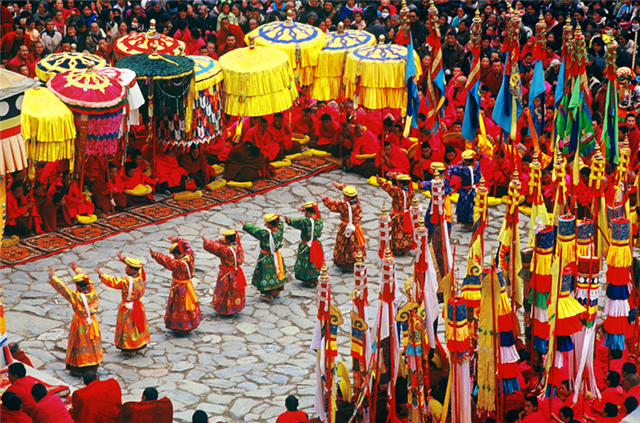
There are many festivals in Labrang monastery. The most famous is Monlam Festival:
Labrang Monlam Festival
The first prayer meeting is called “Monlam” in Tibetan. It lasted 15 days from the third day of the January to the 17th day of the Feburary in lunar callendar. In the meantime, all the monks of Labrang monastery would recite sutras 6 times a day in the Great Sutra hall, among which the fourth time was designed for prayer, praying for the Dharma, love and happiness, and world peace. On the eighth day of the first lunar month, a “release” was held to sprinkle the prepared horses, cattle and sheep with clean water, and tie ribbons on their ears before letting them away. No horse, cattle or sheep is allowed to be hunted. On the 13th day of the first lunar month, the “bright Buddha” was held, hanging dozens of zhang-long embroidered Buddha statues on the foot of the royal palace. The monks recited the bathing sutras, and the masses were awed and the scene was grand. A dance was held on the 14th. On the evening of the 15th, the butter flowers will be held for the lantern fair. The butter flowers made by various colleges and monks are displayed around the Great Sutra Hall, and the butter lamp is served to make the butter flowers more bright and dazzling. After the exhibition, we will compare with each other and arrange the ranking. On the 16th, “Turning Maitreya”, the monks carried Maitreya Buddha around the temple with the accompaniment of the band to show that the future Buddha Maitreya will rule the world. It officially ended on the 16th of the first lunar month, and the cost was borne by the 23 tribes of Labrang Temple in turn.
October Tsongkhapa death memorial. It was held on the 25th day. This day is Tsongkhapa Nirvana Day. Monks read the scriptures, the temple open, let believers worship, the roof of the temple lit lights, brilliant as stars, sincere is a wonder, so it is also called the Lantern Festival.