Sichuan & Chengdu -The Land of Characteristics and Charms (8 days
)
Overview
Recommended Destinations
Chengdu city of education, most tasty food, panda, leisure lifestyle, unique folk custom
Jiajiang Thousand Year Cliff Carving, Handmade Paper making Technology
Mt.Emei Religious charm, breath-taking landscape, paradise for wild lives
Leshan City of Grand Buddha and mystical folklore
Qianwei The only place to experience Steam Narrow Gauge Train -the “Industrial Living Fossil”
Mt.Qingcheng one of the most famous Taoist Holy Mountain, a place to experience the Tao and touch the quiet and elegance
Dujiangyan Miracle of world water conservancy project and model of harmony between human and nature
Pidu Source of ancient Shu, breath-taking countryside landscape
Highlights
- Natural scenery
- Cultural relics
- The world-level heritage
- The folk custom exploration by family visit
- religious charm
- Face-to-face educational exchange programs
- Hands on experience
- Experience of the combination of ancient and modern
Itinerary
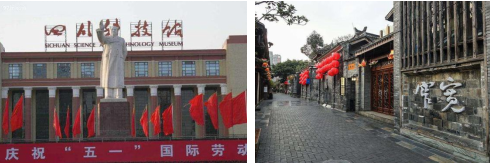
Meet at the airport.Followed by a 1-hour walking Tour of Kuan & Zhai Alleys(Wide and Narrow Lanes). Transfer to the hotel after dinner and the visit of People’s Square(site of Ancient imperial city , Statue of Chairman Mao).
Chengdu is the birthplace of ancient Shu civilization, the best tourist city, the capital of tasty food, leisure culture and time-honored history! It has always been the capital city of the states of all dynasties in China’s history. Famed as one of the five metropolises in China in the Han Dynasty., and one of the most developed industrial and commercial cities in Also Tang Dynasty. In the Northern Song Dynasty, it became as the second metropolises right behind Bianjing. It is where the world’s first paper currency Jiaozi invented Tourist attractions include Dujiangyan Irrigation System, Wuhou Temple, Du Fu Thatched Cottage, Jinsha Site Museum and other places of interest.
Accommodation: Chengdu
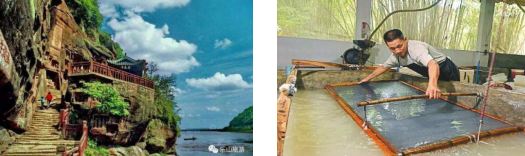
After breakfast, drive to Mount Emei via Jiajiang County(3 hour-bus ride in total). On the way, you can visit of Thousand Buddha Cliff at Jiajiang and experience Paper making Technology(2-3 hour visit). Check in the hotel after arriving in Emei.
Jiajiang boasts beautiful rivers and numerous historic sites. On the left bank of Qingyi River, there are more than 200 grottoes and 2400 Buddhist statues, hence the name “Thousand Buddha Cliff". The statues were carved in the Sui Dynasty and flourished in the Tang Dynasty, extending to the Ming Dynasty and Qing Dynasty. The statues were arranged in a staggered way, occupying one cave at a minimum, and gathering hundreds of statues in one cave at a maximum. The statues were carved with beautiful shapes, exquisite skills, different and colorful postures , which showed the superb level of stone carving art in ancient China. In addition to the cliff statues, there are also a variety of inscriptions.
Accommodation: Emei
Take the bus to the tourist center and transfer to the sightseeing bus to Leidongping (2.5 hour bus ride). Walk for one kilometer to take the cable car to Golden Summit. If the weather is good, you can enjoy the Buddha light and the sea of clouds. After lunch, return to Leidongping and take the sightseeing bus to Wannian temple(1.5 bus ride and 40 minute walk). After the tour, walk down the mountain, by passing White Drangon Cave and Elegant Sound Pavilion to Wuxiangang(1.5 hour trekking), take the sightseeing bus back to the foot of the mountain, and take the bus to Leshan(1 hour bus ride).
Emei Mountain is one of the "four famous Buddhist mountains" in China. It has a steep terrain and beautiful scenery. It is known as "the most elegant mountain in the world". With an elevation of 3099 meters, it is a holy place for Taoist sages and Bodhisattvas. Religious culture, especially Buddhist culture, constitutes the main subjects of its historical culture. There are many historic sites and temples on the mountain, as well as other scenic spots. It is one of China's resort top destinations of tourism, recuperation and summer resorts.
Accommodation: Leshan

Drive to Qianwei to experience-Steam Narrow Gauge Train -the "Industrial Living Fossil"at Jiayang(2 hours). In the afternoon, visit Leshan Giant Buddha (40 minute boat tour). Then drive to Mt.Qingcheng and visit Shrine of Sushi and His Father & Brother in Meishan on the way(1 hour).
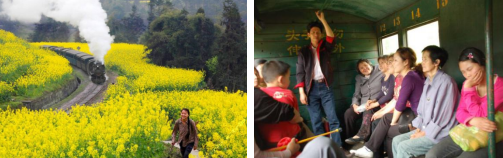
Steam Narrow Gauge Train, which was built in 1958, runs 20 kilometers west of Qianwei County, Sichuan Province. It is the only small passenger steam train still in operation in China and even in the world. Owns the reputation of "living fossil of industrial revolution" which is even more precious than giant panda.
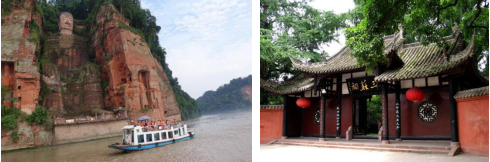
Leshan Buddha, is located at the confluence of Dadu River, Qingyi River and Min River. The statue of Maitreya Buddha was built in the first year of Kaiyuan Period (713) of Tang Dynasty and completed in the 19th year of Zhenyuan Period (803). It lasted about 90 years and reached 71 meters in height, so far the largest cliff stone sculpture in the world.
visit Qingcheng Mountain, a famous Taoist mountain, and in the afternoon, visit the world-famous Dujiangyan water conservancy project. Then dirve to Pixian, the source of Ancient Shu Civilization, to explore the history of ancient Shu culture, experience the real rural scenery of Chengdu Plain, and taste the most authentic Sichuan cuisine.
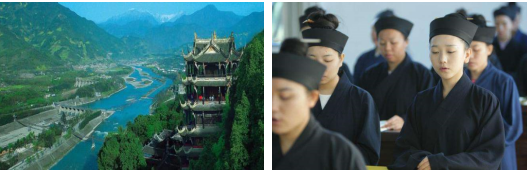
Mt.Qingcheng is one of the four famous Taoist Holy Mountains in China.The whole mountain is filled with thick green trees all the year round. The peaks stand in a ring like the outline of the city, hence the name Qingcheng Mountain which means Green City.
Dujiangyan was built in the late years of Qin Zhaowang Period(about 256-251 B.C.) It is a large-scale water conservancy project organized and built by Li Bing, the governor of Shu State. Composed of water diversion Fish mouth, Feishayan, Baopingkou and other parts, it has been playing an important role in prevention for more than 2000 years The function of flood control and irrigation makes Chengdu plain a "Land of Honey and Milk" . Up to now, the irrigation area has reached more than 30 counties and cities, supporting a population of 19 million . It is the oldest water project still functioning and characterized by water diversion without dam in the world!
Accommodation: Pixian
Visit Wangcong Temple (The Shrine of Ancient Shu Emperors), Youai village, Sichuan Cuisine Museum (learn how to cook). Drive back to Chengdu after lunch(1.5 hours), visit the "Memory of The Eastern Suburbs" scenic spot and experience the industrial development history of Chengdu.
Accommodation: Chengdu
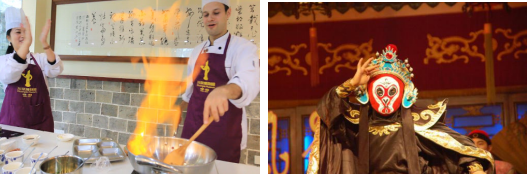
In the morning, visit Panda Base and make close contact with national treasure. In the afternoon, Exchange Activities in local high school. Experience the unique stunts of Mask changing and Fire Blowing of Sichuan opera after dinner.
Accommodation: Chengdu
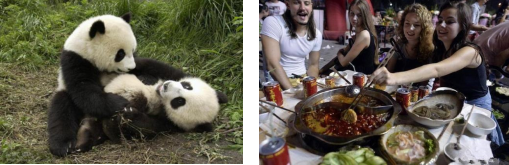
Visit Chengdu Planning Hall, Xinglong lake, experience modern and Pastoral Chengdu. After lunch, a walking tour to Jinli- the Pedestrian Street.
Transfer to the airport for your flight to next city.
Wish you a pleasant trip!!
The Trip Cost Includes
- Pick-up or Drop-off service from and to Airport(in our own vehicle)
- Transportation to and from!!
- Food all along the trip(Breakfast, Lunch, Dinner and a cup of coffee or tea) and accommodations during the trip in hotels with family environment
- Transportation, food, accommodation and insurance of Guide during the trip
- Down jacket, all-season sleeping bag, duffel bag and trekking map(in case if you don’t have your own. Down jacket, sleeping bag and duffel bag must be returned after completion of the trip)
- First Aid Medical Kit(Your guide will carry the Medical Kit but we also advise to bring yourself for your own use, as far as possible)
- All the required permits and paperwork
The Trip Cost Excludes
- International Airfare
- Visa Charges
- Hotel Expenses(In Kathmandu, some packages do include hotel expenses)
- Your travel and medical insurance
- Personal Expenses such as shopping, bar bills, hot shower, telephone, laundry, titbits etc
- Food and accommodations in Kathmandu
- Services not mentioned or not promised by the agent/agency
- Emergency expenses such as expenses on chartered helicopter.
Annapurna Base Camp is a Grade B or a moderately difficult trekking route. So any fit person can do this trek, even if you do not have any previous experience. You should be aware of what to expect and mentally prepare for it. Then, as long as you will to, you can.
On average, you walk about 4 to 6 hours per day. One or two days can be as less as 3hrs and one or two days can be as long as 7hrs.
The highest altitude reached is 4190m. This is the elevation of Annapurna Base Camp. ABC is the highest we will climb in this trek.
Yes, you can charge batteries en route. Charger should be brought. There are hot shower facilities as well. You may have to pay certain amount for both ($1-$2). Negotiate. Also, hot water facility could be free at lower elevation.
No. There are no ATMs on this trek route. You will have to draw enough cash in Pokhara or Kathmandu. There are a number of ATMs in these cities. Everything is paid in Nepali rupees. So money should be exchanged before the start of the trek.
Yes. Internet can be accessed in most places. Sometimes, there might be some technical problems. Internet in Nepal is not as fast as you are used to and at times you can just lose connection.
Not really. It depends on you. If you want, ABC trekking can be done independently. You could hire a guide and a porter by yourself instead of going through an agency or not hire a guide at all. Although, not having a guide can be a little problematic during off season.
It really depends on you. Is it your first time in Nepal? How confident are you of being able to find your way around? How pressed on time are you? If you go through an agency, it will be costlier but everything will be planned. You will only have to come, trek and return.
For Annapurna region, pay for guides range from $20 to $30 per day and porters take $15 to $25 per day.