Historical Significance & Discovery Context
Located in the secluded Linze County approximately 60 kilometers from Zhangye, the Jintasi Grottoes (金塔寺石窟) represent one of China’s most significant yet least-known early Buddhist art treasures. Dating primarily to the Northern Liang Dynasty (397–439 CE)—the very period when Buddhism was systematically establishing itself along the Hexi Corridor—these caves preserve artistic styles that would influence Chinese Buddhist art for centuries. Rediscovered in the 1950s after centuries of near-total obscurity, Jintasi’s relative isolation proved its salvation: while many Silk Road grottoes suffered from vandalism or over-restoration, these caves retain astonishingly pristine early characteristics, offering scholars what archaeologist Dr. Li Jingming calls “a time capsule of 5th-century Buddhist devotion.”
Architectural Innovation & Spatial Philosophy
The complex consists of two primary caves—East and West—carved into a dramatic 60-meter-high cliff face. What immediately distinguishes Jintasi is its pioneering central pillar cave design, where a massive square column extends from floor to ceiling, creating a circumambulation path for ritual walking meditation. This architectural innovation, possibly adapted from Indian chaitya halls via Central Asian intermediaries, would become standard in later Chinese cave temples like Yungang and Longmen. The East Cave measures approximately 10×10 meters with a 5-meter-high central pillar featuring three-tiered niche arrangements that systematically present Buddhist cosmology: heavenly beings above, earthly disciples at eye level, and donor figures below—a vertical hierarchy reflecting spiritual ascent.
Sculptural Mastery & Iconographic Rarity
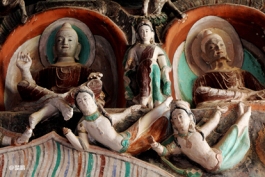
Jintasi’s true treasure lies in its high-relief clay sculptures—an estimated 200+ figures retaining substantial original pigment. Unlike later stone-carved grottoes, these clay works allowed for extraordinary expressive detail. Most remarkable are the “Flying Apsaras” (feitian 飞天), whose dynamic postures appear to genuinely float across cave ceilings, their scarves flowing with wind-swept realism unseen in contemporaneous art. Equally significant are the early Bodhisattva triads showing Maitreya flanked by attendants, displaying distinct Gupta period influences from India combined with Central Asian facial features. Art historian Professor Zhang Xiaogang notes: “The Western Cave’s central Buddha measures 2.8 meters tall, its gentle smile and elongated ears blending Indian prototypes with emerging Chinese aesthetic preferences—this is Sinicization in process.”
Doctrinal Narratives & Comparative Importance
The iconographic program reveals sophisticated doctrinal intent. Scenes from the Jataka tales (Buddha’s previous lives) appear alongside some of China’s earliest depictions of Pure Land cosmology, suggesting the site served both meditation and pedagogical functions. Particularly noteworthy are the Vimalakirti and Manjushri debate scenes—among China’s oldest surviving renditions of this popular Mahayana narrative. When compared with other early sites like Dunhuang’s earliest caves (ca. 366 CE) or Binglingsi, Jintasi displays clearer Indian stylistic roots while simultaneously experimenting with Chinese artistic vocabulary. Its donors—depicted in hybrid Xianbei-Chinese attire—visually document the cultural interactions between steppe dynasties and settled Chinese populations along the Silk Road.
Conservation Status & Research Frontiers
Jintasi faces critical preservation challenges. The clay sculptures, while remarkably preserved, suffer from salt crystallization due to groundwater migration—a problem requiring constant environmental monitoring. Since 2018, a Sino-German conservation project has employed 3D laser scanning and multispectral imaging to document the caves millimeter by millimeter, revealing previously invisible underdrawings and pigment sequences. These technologies confirmed that some sculptures underwent systematic repainting during the Northern Zhou (557–581 CE), providing valuable evidence of changing artistic tastes and religious patronage. Due to fragility, visitor numbers remain strictly limited (typically 30 persons daily), with advance permits required—a policy balancing research access with long-term preservation.
Cultural Legacy & Modern Relevance
Beyond art history, Jintasi illuminates the transmission mechanisms of Buddhism into China. Its location near ancient military garrisons suggests early patronage from both Xianbei aristocracy and Chinese officials—a cross-cultural collaboration that facilitated religious transmission. Modern Buddhist practitioners occasionally visit for quiet contemplation, noting how the cave’s architecture naturally focuses attention inward. For contemporary visitors, the journey itself becomes part of the experience: a 3-kilometer hike through pine forests ending at a ladder ascent to the cliff-face caves creates spatial transition mirroring the spiritual passage these caves were designed to facilitate. As China reevaluates its multicultural heritage, Jintasi stands as testament to how foreign religious ideas were creatively adapted to become profoundly Chinese—a process beginning in these remote cliffs sixteen centuries ago.