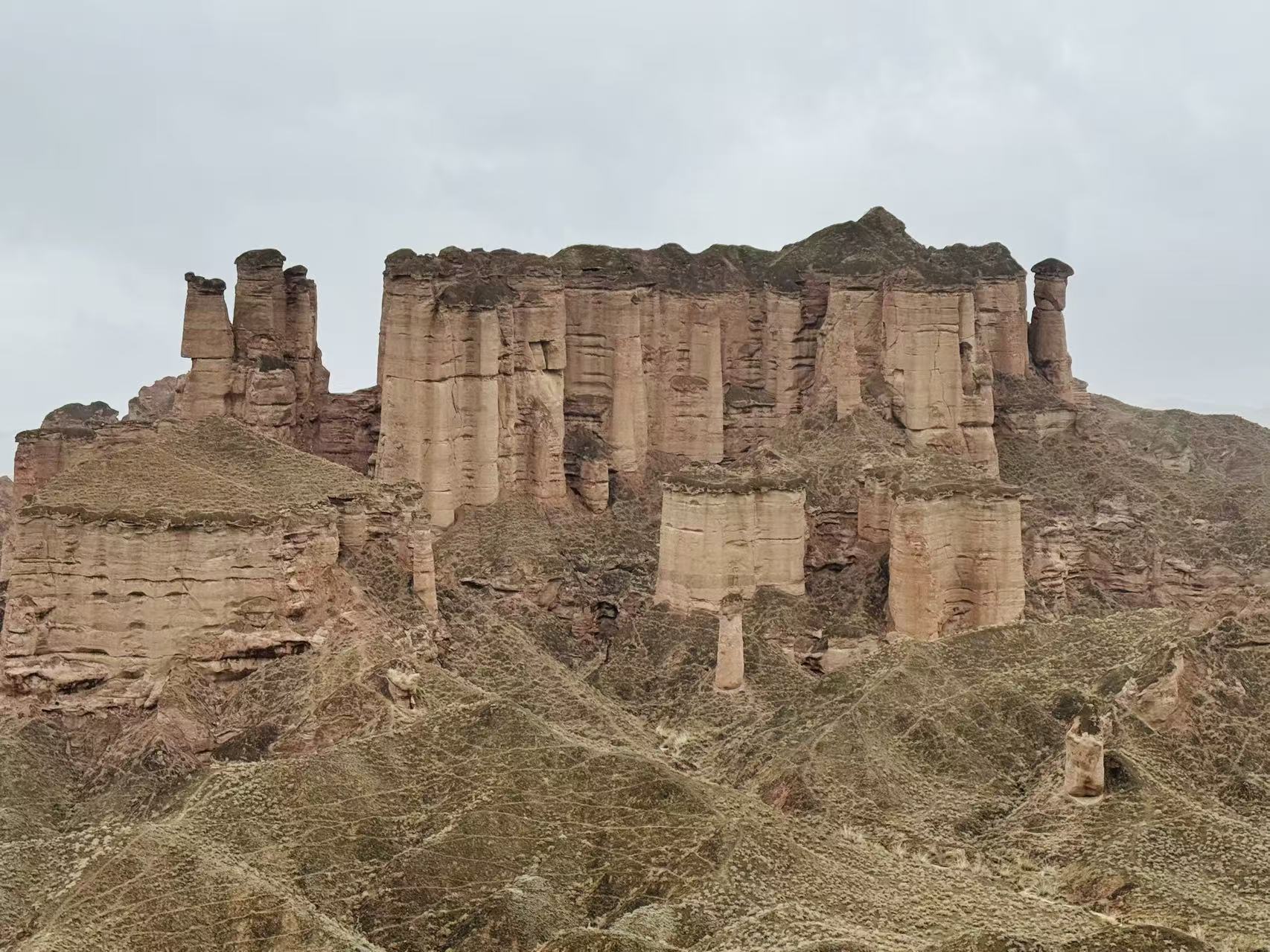
Geological Uniqueness & Formation Process
Bingou Danxia Landform(冰沟丹霞), located 50 kilometers southwest of Zhangye, presents a stunning paradox: fiery-red sandstone formations rising from valleys that host perennial ice formations well into spring. This 30-square-kilometer area represents a rare subtype of Danxia landform where periglacial processes interact with colorful Cretaceous sandstones. While the broader Zhangye Danxia is famous for its “rainbow mountains,” Ice Valley’s distinction lies in its sculptural forms—towers, pillars, and castles shaped not only by water erosion but by freeze-thaw cycles that fracture rock along joints, creating sharper, more vertical features. The “ice” component comes from seasonal accumulations in north-facing crevices where sunlight rarely penetrates, creating surreal juxtapositions of crimson rock and crystalline ice that last until May in shaded gorges.
Morphological Gallery & Scientific Significance
The valley showcases nature’s architectural prowess through named formations like “Luxuriant Palace”—a 50-meter-high cluster resembling Gothic spires—and “Mysterious Castle” featuring honeycomb weathering patterns creating window-like openings. Geologists identify these as textbook examples of “yardang” landforms typically found in hyper-arid deserts, yet here developed under semi-arid conditions with seasonal frost action. Particularly instructive are the “stone curtains”—thin, parallel ridges demonstrating differential erosion rates between hard and soft sandstone layers. Unlike the mineral-rich Zhangye Danxia, Ice Valley’s palette derives primarily from iron oxide variations without significant mineral banding, resulting in more uniform crimson tones that appear ablaze under low-angle sunlight.
Microclimates & Seasonal Transformations
Ice Valley’s fascination lies in its dramatic seasonal metamorphosis. Winter (December-February) transforms the landscape into a monochromatic ice kingdom where waterfalls freeze mid-descent and snow dusts crimson pillars. Spring (March-May) brings the namesake phenomenon: melting ice reveals moss and lichen colonies flourishing in meltwater-fed microhabitats, their green patches contrasting with red rock. Summer exposes the raw geology, while autumn offers crystal-clear air with dramatic shadows. These cycles support specialized biota including cryophilic algae that create subtle green streaks on shaded rock faces, and rock-dwelling ferns surviving in condensation-fed crevices. The valley’s temperature variations can span 30°C diurnally, creating visible exfoliation processes where rock surfaces peel like onion layers—a dynamic landscape visibly changing across human timescales.
Exploration Development & Visitor Management
Opened for systematic tourism in 2015 after geological stabilization, Ice Valley features two main viewing areas: the Grand Valley Circuit with wheelchair-accessible paths to major formations, and the Adventure Valley requiring scrambling through narrow passages. Innovative infrastructure includes cable ladders scaling certain formations and transparent viewing platforms extending over drop-offs for immersive experiences while minimizing ground disturbance. To manage environmental impact, daily visitors are capped at 2,000 with timed entries, and drones require special permits to prevent disturbing nesting raptors. The visitor center’s interactive geology exhibit explains formation processes through tactile models and augmented reality recreations of ancient landscapes.
Photographic Opportunities & Artistic Inspiration
For photographers, Ice Valley offers exceptional conditions. The “Golden Hour” before sunset sets formations glowing, while clear winter days provide deep blue sky contrasts. Unique phenomena include “double-alpenglow” when setting sun illuminates both rock faces and their reflections in seasonal ice pools. The abstract shapes have inspired local artists for generations—contemporary sculptor Chen Long’s “Earth Pagodas” series directly references the valley’s pillar forms. Documentary filmmakers increasingly feature the location for its otherworldly aesthetics, most notably in Chinese science-fiction productions seeking Martian analogues without digital effects.
Conservation Challenges & Research Value
As a younger tourist destination than Zhangye’s Colorful Danxia, Ice Valley implements lessons from overtourism elsewhere. Real-time monitoring systems track footpath erosion and air quality, triggering automatic visitor redistribution when thresholds approach. Scientific research focuses on permafrost degradation monitoring—the valley’s ice formations serve as climate change indicators, with documented reduction in both duration and thickness over the past decade. International geological teams conduct comparative studies with similar formations in Utah’s Bryce Canyon and Turkey’s Cappadocia, contributing to global understanding of sandstone erosion processes across different climatic regimes. Future plans include dark sky preservation initiatives, recognizing the valley’s exceptional night sky visibility for astronomical observation amid dramatic terrestrial forms.
Cultural Context & Future Directions
Though less historically populated than other Zhangye sites, Ice Valley holds significance for local Mongolian herders as seasonal landmark and spiritual site where unusual rock forms are traditionally associated with legends. Modern development carefully incorporates this cultural layer through interpretive signage sharing oral histories alongside scientific explanations. Looking forward, management emphasizes “geotourism” over mass tourism, with specialized guides trained in both geology and ecology offering small-group experiences. As climate patterns shift, the very features defining Ice Valley face transformation—making current preservation efforts not just about protecting a landscape, but documenting a specific climatic moment in Earth’s ongoing geological story.