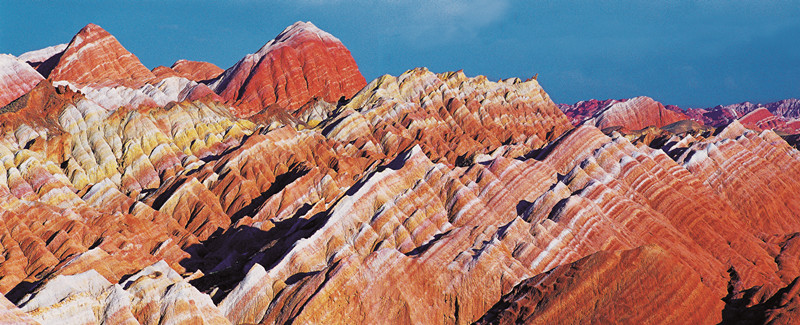
The nominated property is located in Zhangye City, Gansu Province, western China. Centered on Su’nan Yugur Autonomous County, it also extends slightly into Linze County and Ganzhou District. Overall, it lies in the transitional zone between the foreland fault belt on the northeastern edge of the Qinghai-Tibet Plateau and the Hexi Corridor, at the junction of the Qilian Orogenic Belt and the Alxa Block (Song et al., 2013). Positioned in the mid-latitude continental interior, it is characterized by a continental arid climate with abundant sunshine, strong solar radiation, large temperature differences between day and night, and four distinct seasons.
Zhangye Colorful Hills, the nominated property, consists of multicolored fluvial-lacustrine rock formations from the Early Cretaceous that have undergone folding (Wang et al., 2022). Within the property are the Upper Member of the Lower Cretaceous Xinminpu Group, the scenic strata, the southern limb of the Aohe Fold, and the Colorful Hills landform. The nominated property covers an area of 4,646 hectares, with a buffer zone of 4,148 hectares.
The scenic strata of the Zhangye Colorful Hills belong to the Upper Member of the Lower Cretaceous Xinminpu Group (K1xmb), dating back 114 million to 106 million years. These strata were deposited in a continental fluvial-lacustrine environment. The lithology is primarily siltstone and sandstone interbedded with mudstone, featuring a low degree of cementation and poor resistance to weathering. Consequently, these rocks are prone to fragmentation, making it difficult for steep slopes and cliffs to form. Instead, they tend to form gently rounded, relatively low-lying hill landforms. Within the nominated property, the Zhangye Colorful Hills has experienced various tectonic regimes, including intracontinental extension during the Early Cretaceous, intracontinental compression and deformation during the Late Cretaceous, and the massive uplift and expansion of the plateau. These complex tectonic processes and significant topographic changes resulted in diverse depositional environments. Consequently, brilliantly colored strata—red, purplish red, yellow-green, gray-green, gray-black, and more are formed alternately in striking patterns. In addition, external forces such as wind, water, gravity, and freezing have collectively sculpted this unique landform. Each factor and evolutionary stage played an indispensable role in creating the breathtaking beauty of today’s Zhangye Colorful Hills.
Enriching the variety of hilly landform types, the Zhangye Colorful Hills hold an irreplaceable position among global geomorphological landscapes. They exemplify the remote transfer of tectonic stress from plate margins into the continental interior and serve as a critical window on the leading edge of the Qinghai-Tibet Plateau’s growth and outward expansion. Therefore, they reveal the complexity of the plateau’s tectonic evolution during uplift and embody both the striking “marvel” and expansive “vastness” of natural landscapes. The strata’s colors and rhythmic layering reflect the interplay of time and environment, making them an indispensable natural wonder in the Earth’s evolutionary history.