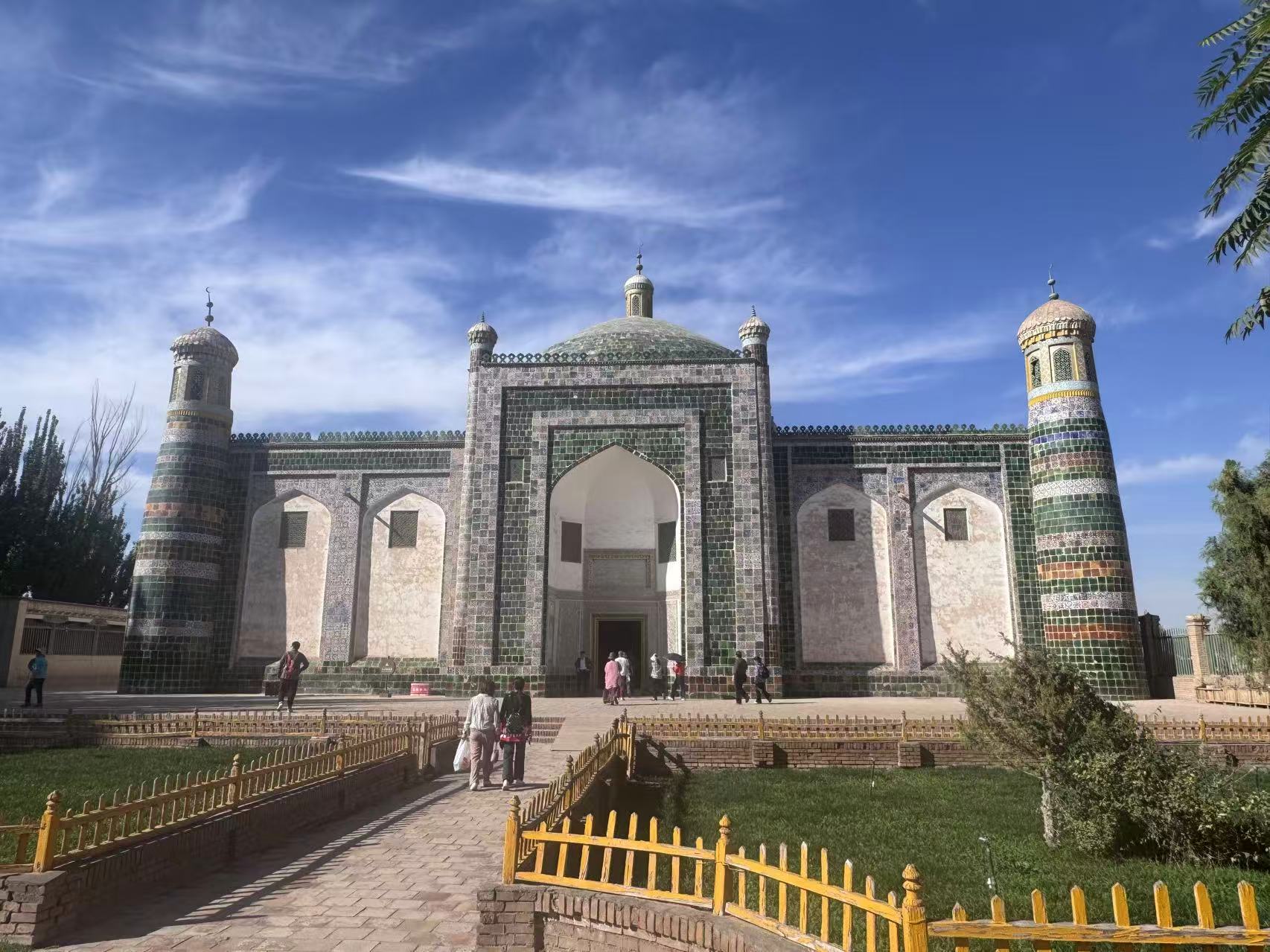
A Mausoleum of Legend and Beauty
In the outskirts of Kashgar lies one of Xinjiang’s most exquisite architectural gems: the Tomb of Xiang Fei, more accurately known as the Apak Khoja Mausoleum. Built in 1640, it is the burial place of the influential Apak Khoja family, powerful Islamic leaders during the 17th century. The site, however, is more famously associated in Chinese lore with “Xiang Fei” (Fragrant Concubine), a legendary Uyghur woman of great beauty said to have married the Qing Emperor Qianlong.
The mausoleum is a masterpiece of Islamic architecture. Its bold, tiled dome, measuring 17 meters in diameter and sheathed in brilliant dark green glazed tiles, dominates the skyline. The entire facade is a dazzling mosaic of intricate floral and geometric patterns in blue, white, and green, creating a serene and majestic aura. The interior is simpler but houses over 70 tombs draped in rich brocades.
While the historical accuracy of the Xiang Fei legend is debated, it adds a layer of romantic mystery that captivates visitors. The true wonder, however, is the building itself—a peaceful, spiritual complex set among poplar trees and smaller prayer halls. It stands as a profound symbol of the deep Islamic heritage and superb artistic craftsmanship of the Uyghur people in Kashgar, making it an essential stop for anyone seeking to understand the region’s cultural soul.